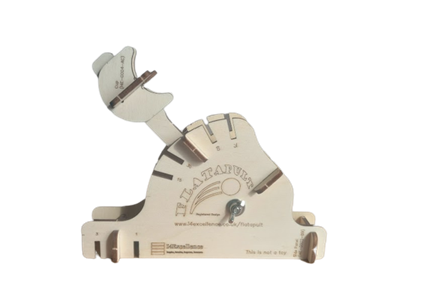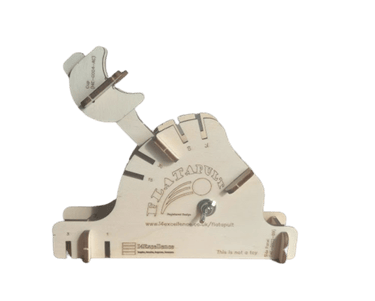
Introducing Flatapult
A compact flat-pack desktop learning aid
Flatapult enables hands-on experience of process, measurement, variation, experimentation for learning programmes in science, engineering, quality and Lean Six Sigma.
As a low cost, easily shipped, sustainable product, Flatapult can be incorporated into classroom, virtual and e-learning programmes, given away to learners as part of the learning package. This allows learners to participate in interactive 'learning by doing' activities throughout their training and allows continued exploration of methods and tools beyond the classroom.
As a combined product and service, Flatapult will provide access to learning exercises and challenges, designed for use with Flatapult hardware and hosted on our website - just point your learners to the challenge and set them free.
Interested to understand more? Contact us... enquiries@i4excellence.co.uk
Already have a Flatapult and are ready to build it - see the 'Flatapult Assembly' page.




Flatapult Manufacture
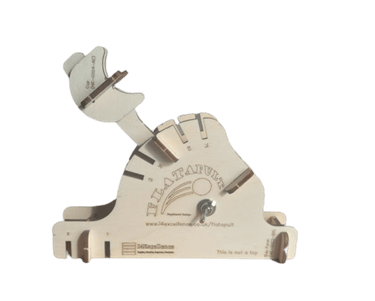
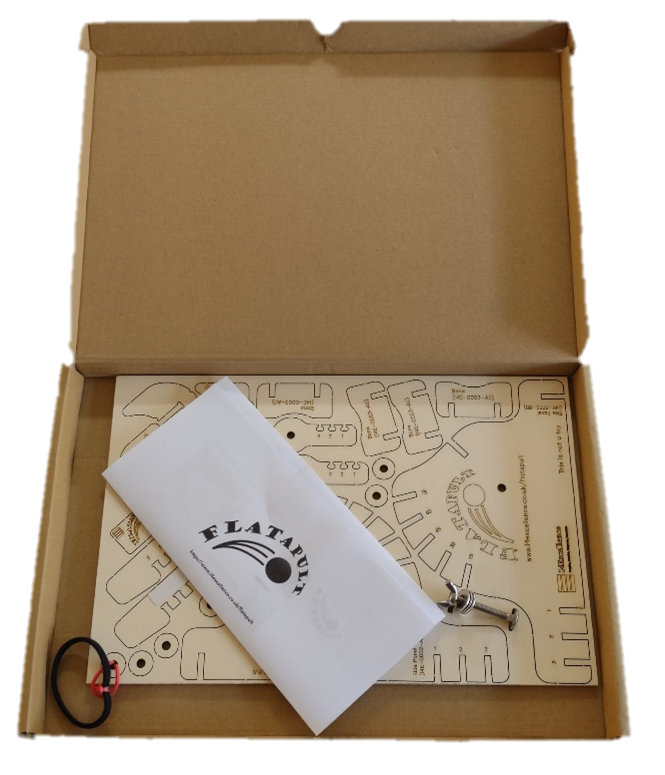
Our Flatapult kits are individually laser-cut
Many people find it interesting to understand how things are made. Manufacturing is hugely important, high technology, digitally driven industry in the 21st century - and it's so often overlooked.
Courtesy of Guy at Surefyre Laser Design, this time-lapse video shows a Flatapult kit being made.

How to build your Flatapult...
Flatapult assembly is quite easy, the video here guides the step-by-step process of assembling the components into a fully functioning catapult. There are three key steps...
Carefully breaking the parts away from the flat-cut board - video link here
Assembling the parts into a functioning Flatapult - see video embedded in this page
Functional test - the Flatapult is designed to launch ping-pong balls
Remember - the assembly guidance is imperfect, you may be tasked to improve this as part of your learning programme!
Characterising, Improving and optimising the performance of the Flatapult... well that's down to you, using the methods, tools, knowledge and skills from your learning programme.
Alternate link to video with subtitle guidance
First-steps - Understanding variability:
1. Experiencing variability.
2. Gaining stability - ‘Standard Operating Procedure’.
Measurement Systems:
3. Define a ‘Standard Operating Procedure’ for measuring Flatapult® performance.
4. Measurement System Analysis.
Process Stability:
5. Review the time-series stability of the Flatapult® process using Control Charts.
Applied Data Analysis:
6. Capability Analysis.
7. Comparisons.
8. Relationships – Regression.
9. Conduct a Design of Experiments.
Lean Process Analysis:
1. Standardisation (Assembly / Change-over Process).
2. Single-piece flow assembly of multiple units.
3. Line balancing.
4. Change-over time reduction / SMED.
5. Maintenance planning / TPM.
Process Simulation:
6. Build a monte-carlo simulation to analyse performance of a multi-stage Flatapult® process.
7. Build a discrete event simulation to analyse performance of a multi-stage process.
Failure-Mode Avoidance:
8. Significant & Critical Characteristics.
9. PFMEA – Assembly & Change-over.
10. DFMEA / ESA – Systems Engineering & FMA Analysis.
Problem Solving & Improvement Methods Consolidation:
11. Full team-based consolidation exercise using a structured framework for problem-solving & improvement e.g. DMAIC.
12. Team-based problem-solving and improvement exercise for a multi-stage Flatapult® process – simulates leadership of a portfolio of improvement and optimisation activities.